The Abdullah Surname: A Political Blessing or an Inherited Burden?
Nov 2, 2026, 23:05 IST
Summary
The debate on whether the Abdullah surname in Indian politics serves as a political advantage or an inherited burden unfolds through the perspectives of Shubhankar Mishra and Omar Abdullah. Mishra highlights both the pressures and benefits of the name, while Abdullah emphasizes personal accountability and inherited responsibilities in political decisions.
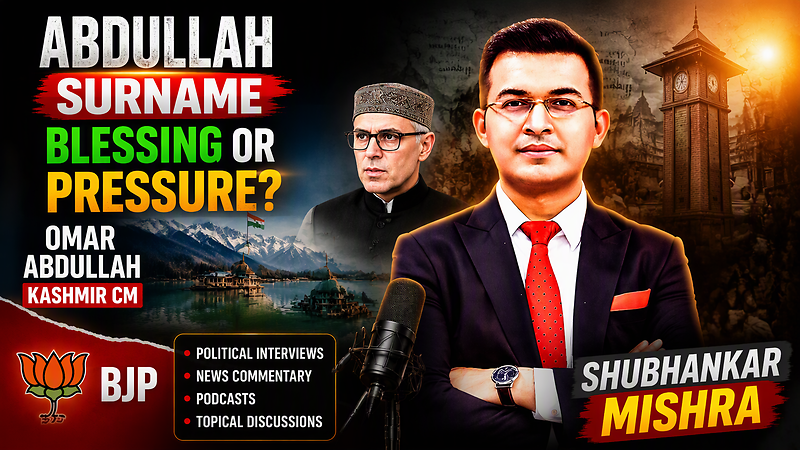
The debate surrounding the Abdullah surname in Indian politics has been reignited, with varying perspectives on whether it serves as a political advantage or an inherited burden. Popular YouTuber Shubhankar Mishra explores this topic in two separate videos, presenting a nuanced view on the implications of the Abdullah legacy.
In his video titled *Abdullah Surname: Blessing or Pressure?*, Shubhankar Mishra highlights Omar Abdullah's acknowledgment of the dual nature of his surname. He states, "the Abdullah surname brings both political pressure and advantages," illustrating that while it can create expectations and scrutiny, it has also opened doors for him in his political career. He notes that members of the Abdullah family, including Omar, have served as chief ministers and have faced significant challenges, including imprisonment. Omar Abdullah himself spent 232 days under house arrest, a reality he faced while celebrating his birthday in confinement. This experience, he argues, adds a layer of pressure that comes with the family name.
However, in a different video, *Abdullah Surname बना बोझ?*, Shubhankar Mishra presents a contrasting perspective from Omar Abdullah, who contends that his political mistakes cannot be solely attributed to his surname. Abdullah insists that personal accountability is vital, stating, "if I am not ready to answer for inherited political decisions, I should not be in politics." He emphasizes that the surname brings inherited responsibilities, such as being held accountable for historical political agreements like the Indira–Sheikh Accord and the Rajiv–Farooq Accord. In this light, he asserts that it is experience, rather than the surname itself, that shapes one's political journey.
The crux of the debate lies in whether the Abdullah surname is a facilitator of political success or a weighty burden. While Shubhankar Mishra, in his first video, underscores the advantages that come with the name, he also acknowledges the pressures that accompany it. Conversely, in his second video, he portrays Omar Abdullah's insistence on personal accountability and the idea that political mistakes arise from individual choices rather than familial legacy.
This discussion illustrates a broader theme in political dynasties: the interplay between legacy and individual agency. While some may view the Abdullah surname as a stepping stone, others highlight the inherent responsibilities and scrutiny that come with it. As the debate continues, it raises essential questions about the nature of political legacies and the expectations placed upon those who inherit them.