The Battle for Media Independence in India: Godi Media vs Free Press Narratives
Nov 4, 2026, 17:30 IST
Summary
The debate over media independence in India features strong criticisms of 'godi media' for its pro-government bias. Abhisar Sharma and Ashok Kumar Pandey highlight failures in media accountability, while Shyam Meera Singh and Sakshi Joshi discuss the implications for women's safety and communal harmony. Meanwhile, voices like Faye D'Souza and Meghnad advocate for resilience and independence in journalism.
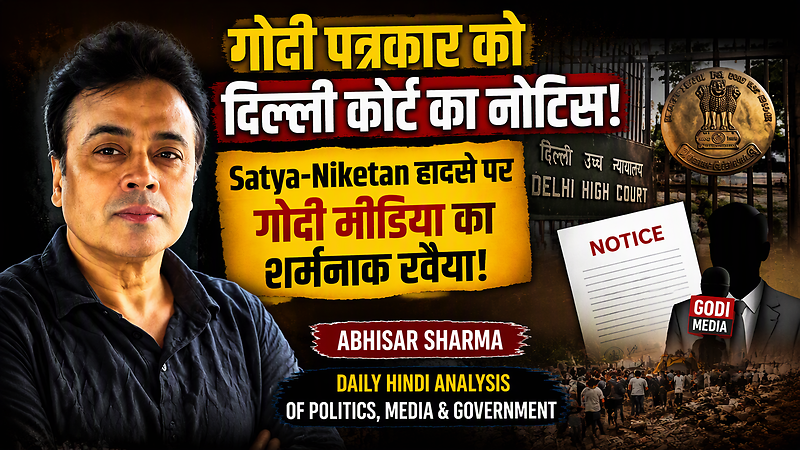
In the ongoing debate about media independence in India, several voices are emerging to challenge the dominance of what is commonly referred to as 'godi media'—a term used to describe media outlets perceived as biased towards the government. Abhisar Sharma, a journalist, argues vehemently against this bias, calling godi media a "curse" on the country’s democracy. He highlights a recent incident involving a Delhi High Court notice issued to journalist Sudhir Chaudhary for defamation, pointing out that the media failed to question the government regarding the tragic collapse of a building in Satya Niketan, which resulted in several student deaths. Sharma states, "Godi media did not ask a single question of the BJP's triple-engine government."
Conversely, Ashok Kumar Pandey critiques godi media's coverage of the Nishu Azad incident, where a public protest erupted following an alleged assault. He notes that media outlets, including Aaj Tak, faced backlash for their biased reporting, asserting that journalists are increasingly seen as agents of the government rather than independent reporters. "The public knows these journalists are here to malign movements," Pandey asserts, reflecting a broader discontent with the media's role in shaping public perception.
Shyam Meera Singh adds a layer of emotional response to the discourse, focusing on the treatment of women in media narratives. He expresses outrage over a viral incident involving Ruchika Singh, where an apology was demanded after she was verbally abused. Singh argues that this incident symbolizes a larger issue of women's safety and representation in Indian media, stating, "The apology is an insult to Indian women."
In a contrasting perspective, Sakshi Joshi emphasizes the importance of friendship across religious divides, suggesting that social media narratives often fuel hatred, particularly since the BJP came to power. She asserts that the government has been effective in dividing communities for political gain, stating, "We are all brothers and sisters."
Faye D'Souza offers a more optimistic view, suggesting that despite the challenges, India's resilience and diversity are strengths that will ultimately lead to positive outcomes. She emphasizes that unexpected events often reveal the country's capacity for recovery and change, which keeps her hopeful.
On the other hand, Saurabh Shukla critiques the accountability of media owners, suggesting that they will eventually face scrutiny for their actions. He notes that the youth in India are awakening to these issues and will demand accountability from media houses that have strayed from journalistic integrity. "The youth have awakened and will no longer remain politically passive," he claims.
Meghnad introduces an interesting angle, stating that many journalists within godi media are dissatisfied with their roles and are seeking independence. He invites these journalists to connect with him for guidance on how to transition to independent journalism. "TV media is officially dead. Why are you even there?" he challenges, indicating a shift towards alternative platforms like Instagram and YouTube.
As the debate unfolds, the perspectives range from calls for accountability and representation to reflections on the resilience of the Indian populace. The tension between godi media and independent journalism underscores a critical moment in India’s media landscape, where the quest for truth and integrity continues to clash with political allegiance and bias.