The BRICS Dilemma: India's Growing Role and Challenges Ahead
Sep 26, 2026, 13:30 IST
Summary
The debate surrounding India's role in BRICS for 2026 highlights contrasting views. Harsh Vardhan Tripathi questions the significance of India's growth rate, while Khanversation sees potential for increased global influence. Dr. Qamar Cheema emphasizes Modi's strategic positioning, whereas Sanjay Kathuria warns of a $226 billion trade deficit. Rachana Ranade advocates for women's financial literacy, showcasing the multifaceted nature of the discussion.
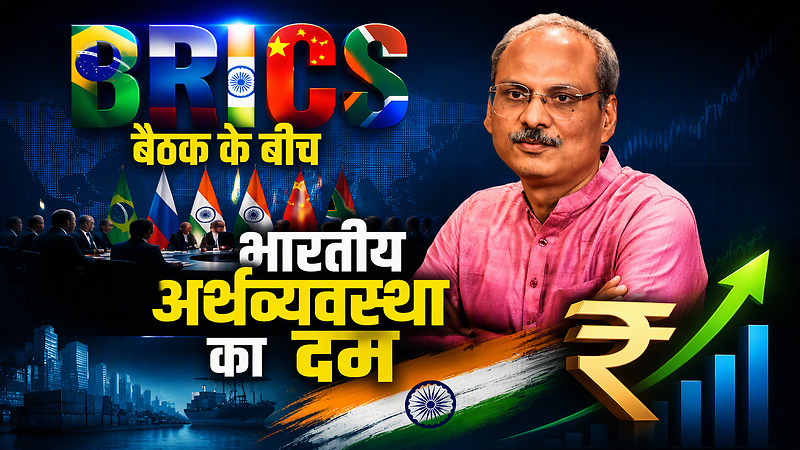
As BRICS prepares for its 2026 summit, the debate intensifies around India's role, the group's agenda, and its overall usefulness. Various content creators are weighing in on these critical issues, presenting a spectrum of opinions that highlight both the opportunities and challenges India faces within this international grouping.
Harsh Vardhan Tripathi, a prominent commentator, argues that India’s recent growth figures, specifically the 7.8% increase for April to June 2026, should not be celebrated without context. He states, "India remains below $5 trillion, versus China above $19 trillion and the US above $30 trillion." Tripathi emphasizes that to truly assess economic growth, one must consider multiple quarters, not just a single statistic.
On the other hand, Khanversation, a popular YouTuber, believes that BRICS can significantly increase its global influence, especially as the United States retreats from its leadership role. He states, "BRICS has a great opportunity to make a growing impact as the United States' leadership declines," suggesting that the bloc's expansion could fill the void left by the US.
Adding another layer to the discussion, Dr. Qamar Cheema offers a perspective focused on Prime Minister Narendra Modi's body language during BRICS meetings. He argues that Modi’s confidence in connecting with leaders like Vladimir Putin and Xi Jinping signals a strategic positioning for India. Cheema observes, "Modi is signalling Trump that India can work with other nations," highlighting the intricate balance India seeks to maintain amid geopolitical tensions.
However, Sanjay Kathuria, another influential voice, presents a starkly different view. He argues that India is incurring a significant trade deficit with BRICS countries, estimating it at $226 billion annually. He notes, "This deficit is more than two and a half times India's entire defense budget," raising concerns about the economic implications of India's involvement in BRICS.
In contrast, Rachana Ranade, a financial educator, shifts the focus to women's financial literacy in India, suggesting that economic empowerment through education is essential for the country’s growth. While her perspective diverges from the geopolitical discussions, it underscores the importance of inclusive economic policies within the broader context of BRICS.
The varying opinions underscore the complexity of India's relationship with BRICS. While some creators like Tripathi and Kathuria express skepticism about the economic benefits, others like Khanversation and Cheema see potential for increased influence and strategic partnerships. This debate illustrates the multifaceted nature of BRICS and India’s role within it, revealing both opportunities for growth and significant challenges that must be navigated as the group evolves towards 2026.