The Unyielding Cycle of Paper Leaks: A Call for Accountability
Aug 15, 2026, 14:59 IST
Summary
The ongoing debate around examination paper leaks in India reveals deep frustrations over systemic failures and lack of accountability. Shubhankar Mishra highlights only one conviction from 148 cases, while others like Ganesh Prasad and Saurabh Shukla question the effectiveness of current legal frameworks. The consensus is clear: significant reforms are necessary to prevent future leaks and ensure justice for affected students.
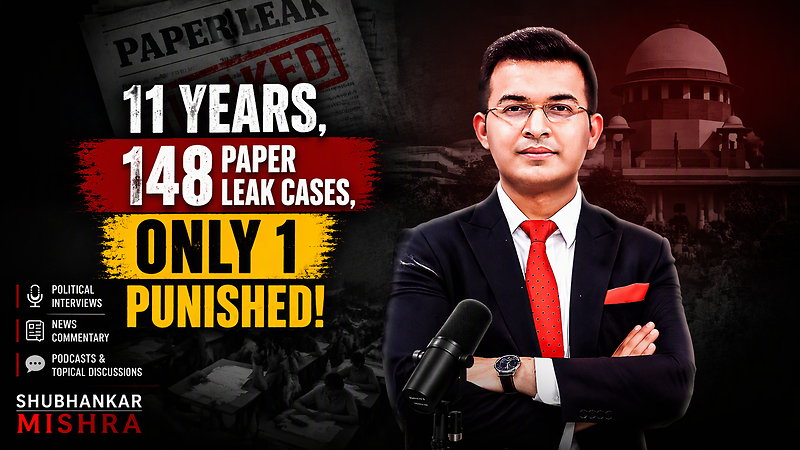
In a disheartening analysis of India's persistent problem with examination paper leaks, Shubhankar Mishra highlights the alarming statistic that since 2015, there have been 148 registered cases but only one conviction. He argues that the culpability for these failures spans all political parties, stating, 'This issue is not just one party's fault; it is a systemic problem.' Mishra's perspective underscores the need for accountability across the political spectrum, suggesting that the same paper-leak mafia operates regardless of which party is in power.
Mishra further elaborates on the mechanics of how these leaks occur in his other video, explaining that a paper’s journey from creation to examination is fraught with vulnerabilities. He points out that papers can sell for exorbitant amounts, ranging from ₹12 to ₹50 lakh, creating a lucrative market for corruption. He emphasizes that while perpetrators are occasionally caught, they often evade justice through bail and legal loopholes, perpetuating a cycle of exploitation.
Ganesh Prasad from Think School presents a more hopeful view, asserting that the Supreme Court's recent directions to introduce computer-based examinations aim to mitigate these leaks. He claims, 'Paper-leak offences carry a ten-year imprisonment, with trials and convictions expected within three months.' However, this perspective raises questions about the actual enforcement of such laws, given the historical context of delayed justice.
Contrastingly, Pragya Mishra, a popular YouTuber, draws attention to the frequency of leaks in Uttar Pradesh under the current administration, citing multiple instances from 2017 to 2023. He expresses frustration over the seeming impunity of those involved, stating, 'I can count the paper leaks on my fingers since Yogi Adityanath's government came to power.' This assertion highlights a perceived decline in accountability, which echoes Shubhankar Mishra's concerns about systemic issues.
Saurabh Shukla from The Red Mike takes a historical lens, recounting a significant paper leak from 2006 that remains unresolved, with no witnesses having testified in court. He illustrates how the very lawmakers tasked with creating solutions to these issues have connections to past leaks, questioning their integrity and commitment to reform.
In a related vein, Gaurav Gogoi, a Congress MP, criticizes the slow legal processes surrounding recent leaks, pointing out that of 45 individuals charged in the NEET-UG 2024 leak, 44 received bail. He laments the lack of seriousness shown by the government, stating, 'This reflects a deep-seated indifference towards the students’ futures.'
In a more critical vein, Akassh Ashok Gupta emphasizes the need for preventative measures rather than punitive ones, arguing that merely instituting fast-track courts and harsh penalties is insufficient. He calls for a comprehensive overhaul of the examination system, questioning, 'How can we guarantee that there won’t be another leak?' He insists that accountability must be established before future incidents occur.
Finally, Anurag Minus Verma addresses the emotional toll these leaks take on students, suggesting that the government's approach should not just focus on punishment after the fact but on ensuring future integrity in examination processes. He asserts, 'Strict punishment should prevent anyone from leaking question papers in the future.'
The debate surrounding paper leaks is layered, with various creators voicing concerns about systemic failures, the need for accountability, and the efficacy of proposed solutions. The consensus seems to be that without significant reform and commitment from those in power, the cycle of leaks will continue unabated.