Can Test and ODI Cricket Survive the T20 Era? A Clash of Perspectives
Oct 31, 2026, 16:30 IST
Summary
The debate over the future of Test and ODI cricket amidst the rise of T20 is heating up. Vikrant Gupta and Rajkumar Sharma express concerns over young players prioritizing IPL, while Tanay Tiwari highlights the declining relevance of bilateral series. Boria Majumdar proposes Test 20 as a potential solution, contrasting with critiques of modern bowling standards by Nikhil Naz and Shubhankar Mishra.
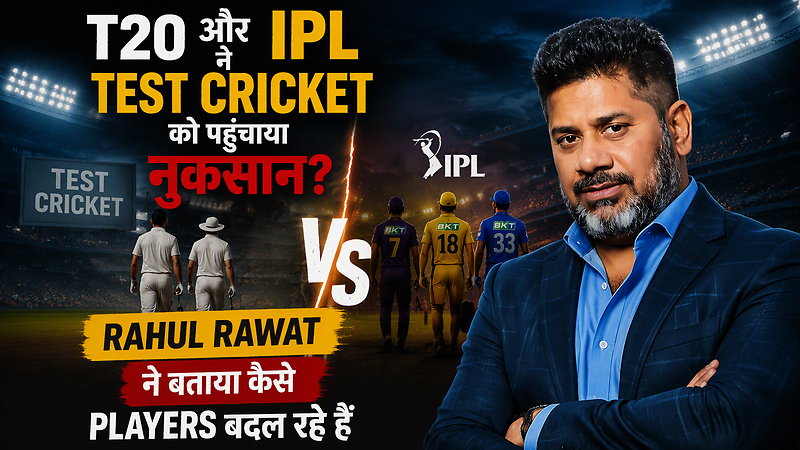
The advent of T20 cricket, particularly through the IPL, has sparked a fierce debate about the future of Test and ODI formats. Prominent voices in cricket discuss the implications of this shift and express varying opinions on whether traditional formats can withstand the onslaught of the shorter game.
Vikrant Gupta, a sports commentator, highlights a significant issue: the disconnect between domestic and international cricket. He argues, "Domestic and international cricket have become too disconnected to trust domestic players," citing the struggles of players like Smaran in the IPL. Gupta emphasizes that the lack of faith in domestic cricket compromises the pipeline for international talent.
Adding to this concern, Rajkumar Sharma, Virat Kohli's coach, expresses disappointment over young cricketers prioritizing IPL over national representation. He states, "Everybody wants to play white-ball cricket only... They aren't looking to play for the country," advocating that players should focus on national pride before the allure of T20 fame and fortune. Sharma believes that strong technique is essential, but warns that T20 players may find it challenging to transition to Test cricket.
Tanay Tiwari offers a broader perspective, indicating that bilateral series are losing relevance. He cites ICC CEO Sanjog Gupta, who noted that uncontextualized series fail to attract audiences. Tiwari explains that without compelling narratives or contexts, even powerhouse nations like India struggle to secure sponsorship for home series, raising concerns about the viability of traditional formats in an era dominated by T20.
In contrast, Boria Majumdar presents an innovative idea: Test 20, a format combining elements of both Test and T20 cricket. He argues that this format, which promotes gender parity and could serve as a bridge between traditional and modern cricket, represents a viable investment opportunity. Majumdar asserts, "If this kind of a brand is not a proper investment opportunity, then what is?" He believes that Test 20 could attract audiences while retaining the essence of both formats.
However, the challenges of T20's impact on player development are evident. Nikhil Naz points out that the smaller boundaries in IPL games have led to a decline in quality spin bowlers. He argues that advertising and cheerleader arrangements are compromising the game by reducing boundary sizes, making it harder for bowlers to take wickets.
Gupta further criticizes the trend of producing flat pitches across formats, questioning the rationale behind such decisions. He reflects on how earlier pitches were designed with strategic considerations, unlike the current trend that seems to cater to broadcasters' preferences without a cricketing logic.
Shubhankar Mishra offers a final perspective, noting that modern bowlers appear weaker despite advancements in nutrition and technology. He suggests that the pressures of T20 cricket have altered their mindset, impacting their performance in longer formats. He calls for cricket boards to ensure that Test bowlers train specifically for the demands of their format, advocating for separate training regimens to maintain the integrity of Test cricket.
The debate surrounding the future of Test and ODI cricket in the T20 era is complex, with voices both lamenting the decline of traditional formats and proposing innovative solutions to keep them alive. As the cricketing landscape evolves, the fate of these formats remains uncertain, contingent upon how the cricket community navigates these challenges and opportunities.