1.95 Lakh Blocking Orders: A Clash of Moderation and Censorship
Nov 3, 2026, 19:51 IST
Summary
The debate over 1.95 lakh blocking orders in India highlights tensions between moderation and censorship. Ajit Anjum and Arfa Khanum Sherwani criticize government actions that limit internet freedom, while Yogendra Yadav discusses threats faced by journalists. Pooja Prasanna reveals alarming statistics on blocking orders, and Abhisar Sharma warns of plans to restrict social media for under-18s, raising concerns about stifling dissent.
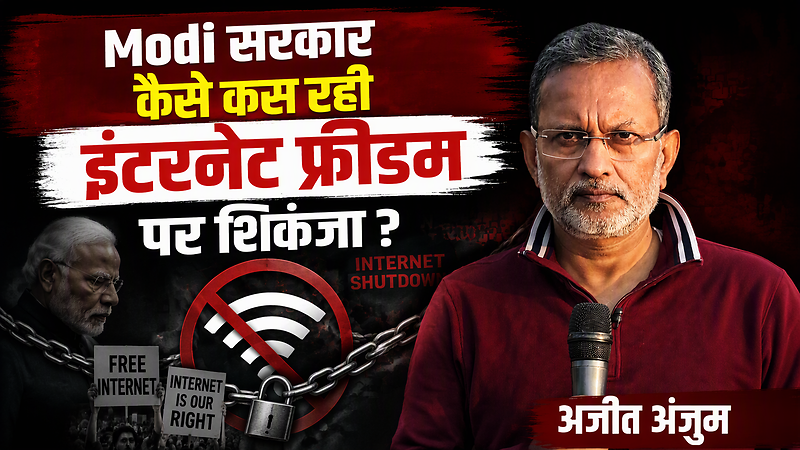
The recent surge of 1.95 lakh blocking orders issued by the Indian government has ignited a fierce debate on the thin line between moderation and censorship in social media. Ajit Anjum, a journalist, raises concerns about India's deteriorating internet freedom, citing a Freedom House report that ranks India at 51 in internet freedom, down from 58 in 2014. He argues that such restrictions are prevalent during protests, noting that during the recent CJP protests, internet access was cut off in a three-kilometre radius around Jantar Mantar to prevent information from going viral.
Arfa Khanum Sherwani, a prominent commentator, echoes Anjum's sentiments but adds a personal touch by highlighting the political implications of these actions. She points out how Meta, the parent company of Facebook and Instagram, has become entangled in the government's censorship tactics, mentioning that Arvind Kejriwal's account was restricted after he voiced concerns about Modi's posts being suppressed. Sherwani criticizes Modi for treating social media platforms as enemies, emphasizing that even the CEO of Meta had to apologize for a perceived mistake involving the removal of Modi's posts.
In a similar vein, Yogendra Yadav, a political activist, underscores the challenges faced by journalists in India. He recounts how four journalists reporting on the tragic deaths of children in Balaghat had their Instagram accounts suspended, illustrating the risks involved in reporting on sensitive issues. Yadav argues that the media's freedom is under siege, as journalists face threats and censorship while attempting to fulfill their duties.
Contrasting these perspectives, the creator of the Khanversation original channel speaks to a broader audience about resilience in the face of censorship. After his original channel was blocked, he reassures supporters, especially those in India, that he will persist in sharing geopolitical updates, even if it means launching new channels. This reflects a determination among some creators to continue their work despite increasing censorship.
Pooja Prasanna, another commentator, presents stark statistics regarding the blocking orders, revealing that between March and July, the government issued an order approximately every 68 seconds. She emphasizes the scale of these actions, pointing out that a single order could encompass multiple posts, thus raising questions about transparency and the grounds on which content is deemed unlawful. According to her, many of these orders coincided with student protests, further suggesting that the government is keen to suppress dissent.
Abhisar Sharma, a journalist, adds another layer to the discussion by highlighting the government's plans to restrict social media access for individuals under 18. He argues that this move could stifle young voices that have recently emerged in social media activism. Sharma links this to the larger trend of censorship, indicating that the government is not only targeting established voices but also attempting to silence the next generation of activists.
This multifaceted debate reveals a concerning trend in India's approach to social media regulation. As voices from various corners express their apprehensions about censorship, the underlying question remains: is the government genuinely moderating content for safety, or is it curbing dissent and freedom of expression?