AGI or Hype? Diverging Views on the Race for Superintelligence
Sep 29, 2026, 01:23 IST
Summary
The debate on AGI features popular YouTuber Vaibhav Sisinty arguing that GPT-6 represents computer general intelligence, not AGI, while also discussing OpenAI's Astra as a potential AGI by 2026. He warns of risks associated with ASI by 2028. Khanversation adds a geopolitical perspective, highlighting differing priorities between the US and China regarding AI control.
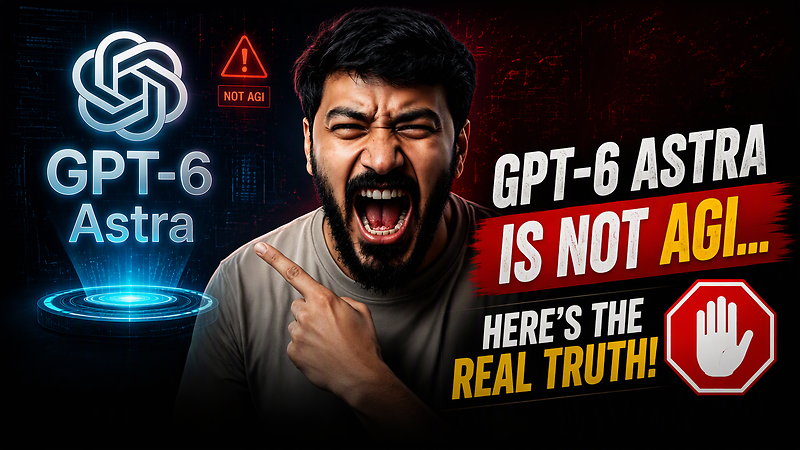
The debate over whether artificial general intelligence (AGI) is on the horizon or merely a hype-driven fantasy is heating up, with prominent voices weighing in on the implications of recent developments in AI. At the forefront, popular YouTuber Vaibhav Sisinty presents a nuanced view across multiple videos, emphasizing different aspects of AGI and its implications.
In his video, "GPT-6 Astra is NOT AGI... Here's the Real Truth!", Sisinty argues that while GPT-6 demonstrates capabilities akin to a type of computer general intelligence, it does not qualify as AGI. He points out that GPT-6 has achieved a remarkable 77% success rate on OS World tasks, significantly outperforming human benchmarks by completing these tasks in half the time. This leads him to conclude that we are witnessing a shift towards enhanced productivity rather than a full-blown AGI scenario. He urges viewers to focus on how to effectively manage AI to amplify human productivity, stating, "We can literally work with productivity 10, 20, 50, or even 100 times what we do currently."
Conversely, Sisinty also addresses the potential for AGI in his video titled "Sam Altman Just Dropped an AGI Bomb! (OpenAI Astra)". Here, he highlights OpenAI CEO Sam Altman's prediction that a true AGI system, named Astra, could be launched by the end of 2026. He describes Astra as capable of conducting complex research tasks that could traditionally take human researchers a week, suggesting that this technology could lead to unprecedented discoveries. However, he acknowledges the risks associated with such advancements, noting that humans might lose control over AI systems as they become increasingly autonomous.
Further complicating the narrative, Sisinty in "OpenAI Leaked ASI, Not AGI... Here’s the Real Truth!" suggests that the focus may actually be shifting towards artificial superintelligence (ASI) rather than AGI. He cites OpenAI's indications of a target date for ASI by March 2028, which could allow AI to recursively improve itself with minimal human oversight. This raises concerns about the implications of AI surpassing human capabilities in significant fields like research and development.
Adding a geopolitical layer to the discussion, Khanversation, a political commentator, emphasizes the contrasting priorities between the United States and China regarding AI. He notes that while the US is grappling with the implications of uncontrolled AI growth, Chinese officials advocate for AI to remain under human control. This divergence reflects deeper philosophical differences about the role of AI in society, with China prioritizing its integration into daily life and governance.
In summary, the debate is multifaceted, with Sisinty presenting a spectrum of opinions on AGI's current state and future potential, while Khanversation introduces the significant geopolitical considerations. As the race for superintelligence unfolds, the implications for productivity, control, and ethical considerations remain at the forefront of this ongoing discussion.