IT Cells and Bot Armies: Shaping or Poisoning Political Debate?
Oct 26, 2026, 07:30 IST
Summary
The debate on IT cells and bot armies in politics reveals contrasting views. Ashok Kumar Pandey criticizes the BJP's misinformation tactics, while Sanjay Dixit defends the party's record on women's rights. Yogendra Yadav emphasizes the importance of protests in democracy, and Meghnad raises concerns about the BJP's digital strategy. Archit Vats warns of the impact of bot accounts on public discourse.
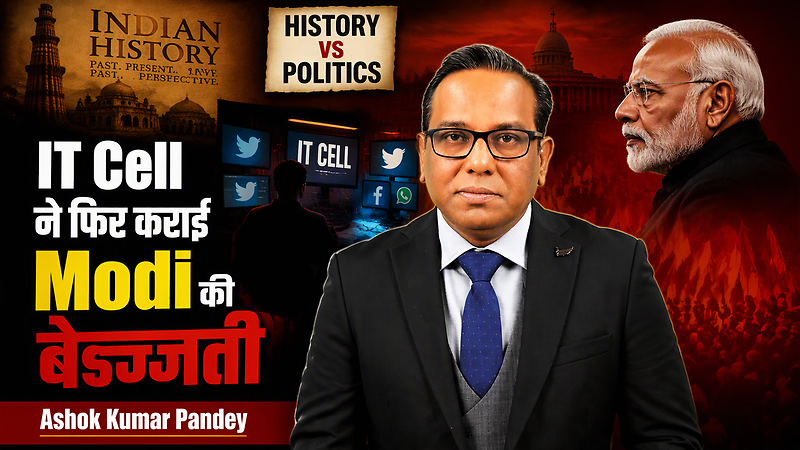
The role of IT cells and bot armies in shaping political discourse has sparked a heated debate among various content creators. On one side, Ashok Kumar Pandey criticizes Prime Minister Narendra Modi for his arithmetic blunders during a recent speech in Australia, suggesting that the BJP's IT cell is struggling to cover up these gaffes with misinformation. He argues that the BJP is misrepresenting the history of nuclear sanctions with Australia to portray Modi's leadership in a favorable light. 'The reality is that the sanctions were lifted in 2011, during Congress rule,' he states, underscoring the misleading narrative pushed by the BJP.
In stark contrast, Sanjay Dixit of The Jaipur Dialogues defends the BJP's IT cell, asserting that Congress has a poor record on women's rights, despite its claims. In a rap format, he highlights that while Congress ruled for sixty years, it failed to pass critical legislation like the women's reservation bill. Dixit’s argument hinges on the notion that the BJP is genuinely empowering women, unlike its predecessor.
Yogendra Yadav adds a layer of complexity to the discussion, arguing that public protests are a vital component of democracy, especially when institutional pathways are blocked. He believes that the current state of Indian democracy necessitates that citizens take to the streets, as peaceful protests serve as a counterbalance to ineffective institutions. 'We haven't destroyed democracy; we are saving it,' he asserts, emphasizing the importance of collective action.
Meanwhile, Meghnad from Digital Indian expresses skepticism about the BJP's new IT cell chief, Deepak Maske, suggesting that despite his background in data analytics, the party’s online presence remains problematic. He points out that many of Maske's previous inflammatory posts have been deleted, raising questions about the sincerity of the BJP's approach to digital engagement. He quips, 'Facebook is dead, and the real battle is on platforms like Instagram,' implying that the party needs to adapt to changing social media dynamics.
In a similar vein, Aadi from Def Talks discusses the shift within the BJP’s IT cell, noting that the new team includes several notable figures and hints at a potential shift away from the previous aggressive tactics. However, he acknowledges that mistakes have been made, suggesting a need for a more balanced approach.
Sanjay Rajoura, from The Fourth Dimension, criticizes the government’s handling of protests, referencing past police brutality at demonstrations and asserting that the current generation must awaken to the necessity of dissent against an indifferent government. He warns that complacency could lead to dire consequences for future generations.
Lastly, Archit Vats draws attention to the prevalence of bot accounts on social media, particularly in relation to political figures like Raghav Chadha. He notes that while Twitter has removed millions of bot accounts, platforms like Meta are still rife with them, creating an environment where misinformation can flourish. He warns that these bots are used to manipulate public opinion and drown out genuine discourse.
This ongoing debate highlights a significant divide in perspectives on the role of IT cells and bot armies in shaping political narratives. While some defend these strategies as necessary for political engagement, others view them as tools for deception and manipulation.