Is AI the Next Dot-Com Bubble? A Deep Dive into Competing Perspectives
Oct 31, 2026, 11:00 IST
Summary
The debate over whether AI represents the next dot-com bubble features diverse perspectives. Sharan Hegde warns of unsustainable investment practices, while Neha Nagar highlights AI's potential for innovation. Shashank Udupa raises concerns about reliance on AI tools, and Sanjay Kathuria discusses alarming losses in China's AI market, underscoring the uncertainty surrounding AI's future.
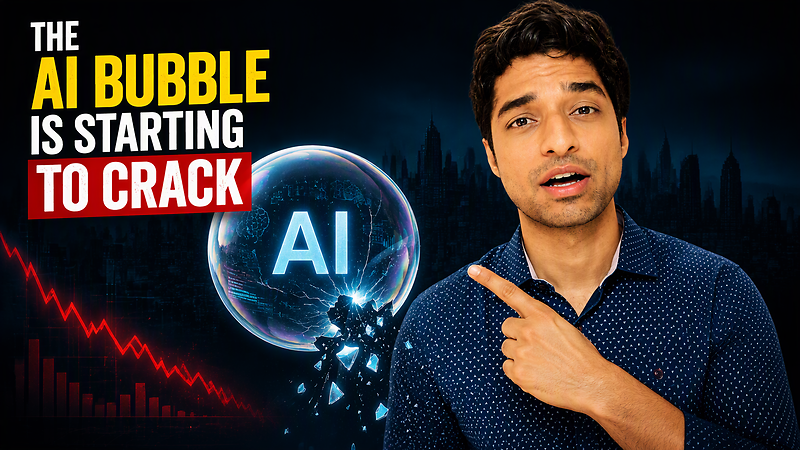
As the artificial intelligence sector continues to surge, a pressing question arises: Is AI the next dot-com bubble? Various voices in the debate offer differing perspectives on the sustainability and future of AI investments.
Sharan Hegde, a popular content creator, raises concerns about the current AI investment climate. In his video, "The AI Bubble Is Starting to Crack," he highlights that a handful of companies dominate the market, with AI accounting for 25 to 50% of valuations in major indices like the Nasdaq and S&P 500. Hegde notes that while $1.1 trillion was invested in AI last year, it only generated between $100 and $200 billion in revenue, indicating a troubling financial architecture. He warns, "It's only a matter of time when this financial architecture around AI will start correcting."
In a follow-up video titled "When will AI Bubble Pop?" Hegde elaborates on the unpredictability of bubbles. He likens the current frenzy to historical bubbles, stating that "nobody can tell you when a bubble will pop because that's what precisely makes it a bubble." He cautions that human psychology can lead to rapid panic selling, which could destabilize the AI market.
Contrastingly, Neha Nagar, a content creator with experience in the tech industry, offers a more optimistic view. In her video, "AI Disruption vs the Dot-Com Bubble," she draws parallels between the emergence of AI and the rise of the internet in the 1990s. Nagar argues that, like the internet, AI will lead to significant disruption and innovation. She emphasizes that the success of AI will depend on how the technology is utilized, citing her own experience with Naukri.com, which has successfully integrated technology to serve both companies and recruitment consultants.
On a more cautionary note, Shashank Udupa, another popular influencer, shares alarming insights from a friend in the AI sector. In his video, "AI Coding In A Bubble?" he explains that many organizations are rushing to produce AI demos without clear revenue outcomes. He highlights a trend where junior developers rely heavily on AI tools, leading to what he calls "technical debt" that could result in platform failures within two years. Udupa predicts that once management realizes that AI investments aren't yielding significant returns, layoffs and budget cuts may follow.
Meanwhile, Sanjay Kathuria, a financial analyst, brings an international perspective. In his video titled "China AI bubble burst. what is the future?" he discusses the dire situation in China's AI market, where companies have lost $480 billion in just a few days. He notes that the CSI 300 index has dropped 20%, emphasizing that global AI giants are also facing pressure to prove profitability rather than just promising future capabilities. Kathuria's stark warning suggests that the AI market's initial promise is now being scrutinized for tangible results.
The debate about whether AI is headed for a bubble mirrors discussions from the dot-com era, with varying degrees of optimism and caution. While some, like Hegde and Udupa, express concerns about unsustainable growth and potential market corrections, others, like Nagar, advocate for the transformative potential of AI. Kathuria's insights on the international landscape further complicate the picture, illustrating that the future of AI investments remains uncertain and fraught with challenges.