Starlink vs Jio: A Battle of Fair Competition or Satellite Monopoly?
Oct 25, 2026, 14:12 IST
Summary
The debate over Starlink and Jio highlights contrasting views on competition in India's satellite internet market. Faye Dsouza asserts regulatory support for multiple providers, while Ishan Sharma critiques Starlink's pricing. Anant Ladha discusses approval delays, and Shashank Udupa emphasizes Jio's competitive strategies. Overall, opinions reveal a complex interplay between innovation and established business practices.
As the competition heats up in India's satellite internet market, voices from various creators reveal a complex landscape filled with contrasting opinions about Elon Musk's Starlink and Mukesh Ambani's Jio. The central question remains: Is there fair competition, or is a satellite monopoly forming?
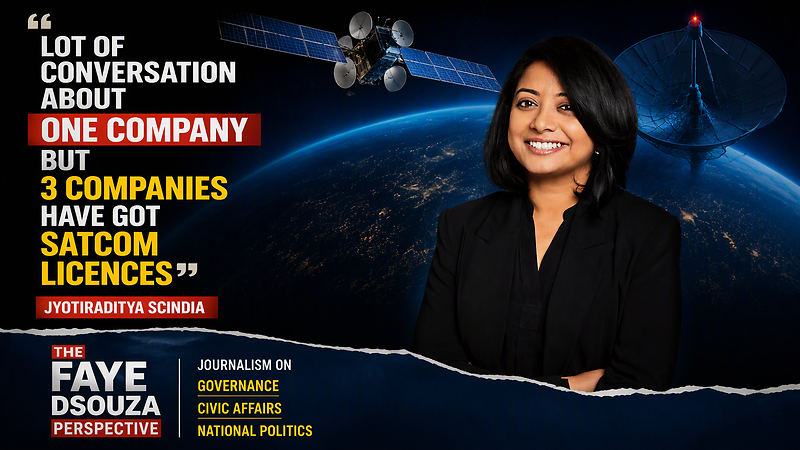
Faye Dsouza, a popular journalist, emphasizes that the Indian Department of Telecommunications is committed to preventing monopolies. She points out, "India does not allow a monopoly in any sector... there are three parties that have got licenses: Reliance Jio, OneWeb, and Starlink." Dsouza's assertion highlights the regulatory framework that encourages multiple players in the market, including Amazon's Kuiper, which is also seeking a license.
In contrast, Ishan Sharma, a content creator, critiques the pricing strategies of Starlink and Jio. He notes, "Starlink costs about ₹8,000 monthly, while Jio charges ₹15 per gigabyte," suggesting that Starlink's high prices could alienate potential customers. Sharma expresses concern that Musk's appeal to the Indian Prime Minister for fair competition may backfire, uniting Indian consumers against Starlink.
Anant Ladha, another commentator, delves into the approval process for satellite services in India, stating that security compliance issues are holding up approvals for both Starlink and Jio. He mentions that Starlink received its telecom license in June 2025 and IN-SPACe approval in July. However, he refutes Musk's claims that Ambani is blocking Starlink's entry, asserting, "The Indian government has rejected these allegations."
Shashank Udupa, a popular YouTuber, reinforces this perspective by noting that Ambani is launching his own satellite service to offer low-cost internet, which directly competes with Starlink. Udupa argues, "If that happens, I don't think it'll be easy for him to justify his own valuations," referring to Musk's reliance on entering the Indian market.
Meanwhile, Airtel's Sunil Bharti Mittal claims his company is ahead in the queue for approvals, stating, "I applied five years back... I have my ground network ready for the last 3 years." This assertion adds another layer to the debate about who is truly positioned to succeed in India’s satellite internet landscape.
In a somewhat provocative stance, Global Politics with Dr. Qamar Cheema interprets Ambani's professional response to Musk as a strategic move to provoke Indian sentiment. Cheema argues that the Indian government tends to favor domestic companies like Jio for their leverage and local employment benefits, stating, "the Indian government prefers domestic companies because they provide greater leverage."
Sharan Hegde, another content creator, expresses skepticism about Musk's intentions in India, suggesting that his entry into the market is fraught with challenges. He concludes, "Let Mukesh Ambani and Airtel take it; I would not go with Starlink at all."
Overall, the debate encapsulates a clash between innovation and established business practices, with each creator bringing unique perspectives to the table. While regulatory frameworks appear to encourage competition, the contrasting pricing, approval processes, and strategic moves by established players like Jio and Airtel complicate the narrative of fair competition versus monopolistic tendencies in the burgeoning satellite internet sector.